













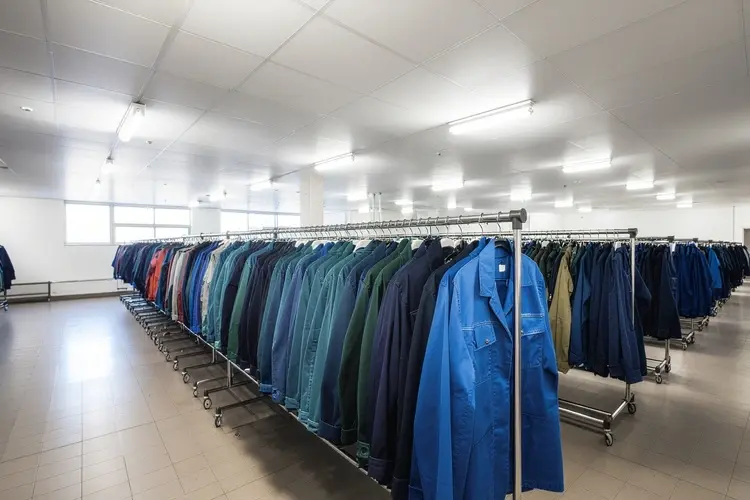
Industrial garments create a recurring movement problem. Clean items must reach the right wearer, returned items must leave the work area, and anything damaged, missing or incorrectly allocated needs a different route. When those steps depend on memory, the business still performs the work, but it cannot easily see where time or stock is being lost.
A workwear laundry service can bring that movement into one agreed cycle. The strongest benefits are practical rather than promotional: regular handovers, clearer garment status, a defined exception path and account information that helps a coordinator act. These are managed uniform laundry benefits only when they solve a known problem in the existing arrangement. Laundry does not select PPE, establish compliance or guarantee savings.
Turn garment movement into a visible cycle
Map the current journey from issue to use, return, cleaning and reissue. Note where items wait, who handles them and how a wearer reports a problem. Unmanaged arrangements often contain several hidden queues: garments left near a change room, replacements waiting for approval or returns that no longer match an active wearer.
A managed cycle gives each queue a defined handover. The value is not that every item moves instantly. It is that normal movement and unresolved exceptions can be distinguished. Managers can then address the actual delay instead of ordering more garments whenever availability feels uncertain.
Mark the point at which the customer’s responsibility ends and the provider’s begins at every handover. The return cage, collection scan, delivery point and internal distribution may each have different owners. Making those transitions visible helps diagnose a missing item without assuming the garment disappeared inside the laundry stage.
Keep clean stock and wearer allocations intelligible
An allocation record connects a wearer or role to the garments expected in the programme. It helps the coordinator recognise a duplicate issue, a departure that was never closed or a role change that needs a different item. The record should be simple enough to update when the workforce changes.
Physical organisation matters just as much. Clean garments need an agreed return location and a method that lets wearers identify their items. If lockers or another distribution system are proposed, test the layout against shift changes and available space. A sophisticated account record does not solve a congested or confusing handover point.
Keep inactive and temporary wearers distinguishable from permanent allocations. A person on extended leave, a contractor nearing departure or a role awaiting approval can otherwise distort stock requirements. The customer should define the status and tell the provider when it changes.
Make exceptions part of the service design
Damage, poor fit, missing identification and unusual soil are not routine laundry. Give each concern a route that identifies the item, observable issue, person reporting it and next decision-maker. The laundry can hold and report an item without being expected to determine technical suitability.
Ask how repairs and replacements are authorised and how account information changes afterwards. If a replacement enters the pool but the old allocation remains active, the apparent stock position becomes unreliable. Closing the record is part of closing the exception.
Create a short exception vocabulary that everyone understands: fit review, visible damage, identity problem, missing return and unusual condition. These labels do not decide the outcome. They route the item and make reports comparable, reducing long free-text messages that omit the garment or wearer identity.
Use reporting to direct attention, not create paperwork
Reporting is useful when it answers an operating question. A coordinator may need to see current wearers, recent deliveries, open changes or items associated with a location. Decide which information will be reviewed, by whom and what action follows a discrepancy.
Avoid requesting every available report simply because the platform can produce it. A smaller set reviewed at the right interval is more valuable than a large export no one owns. The provider supplies agreed account information; the customer keeps wearer and approval inputs current.
Choose reports that support those statuses. A delivery history may answer a disputed handover; a wearer list may expose an old allocation; an open-change view may show where an approval is waiting. Each report should have a question and a follow-up action before it becomes part of the account routine.
Evaluate cost through the work displaced
Savings should be calculated from the existing operation, not assumed from the rental model. Record internal purchasing activity, stock counts, ad hoc collections, time spent tracing garments, and the handling of repairs or changes. Then compare those tasks with the services and customer responsibilities in the proposal.
This reveals whether the arrangement replaces real work or adds another layer around it. Contract price remains important, but it belongs beside the effort retained inside the business. A managed service may still be worthwhile for visibility or consistency even where a simple cash saving is not established.
Include transition costs and retained tasks in the comparison. Initial wearer information may need cleaning, handover points may need preparation and managers may still approve changes after implementation. Recording these tasks produces a more honest business case than comparing invoice value with an incomplete estimate of the current arrangement.
Connect the benefit to published Cleantex capabilities
Cleantex’s managed industrial workwear service publishes cleaning, restocking, delivery, repair or replacement support, and customer tracking and reporting. Those capabilities are relevant when a business wants the garment cycle to become visible. The proposal still needs to state the ranges, records, service intervals and exception terms that apply to the particular account.
This bounded comparison keeps the commercial claim accurate. Cleantex can be assessed for the work it publicly describes, while the customer retains garment approval, workforce information and decisions outside the agreed service. Industrial, sector or safety expertise should not be inferred from a laundry feature alone.
If the required records or response routes are not part of the offered account, decide whether the operating benefit still exists. The answer may be yes where reliable collection and delivery solve the main problem. The business case should name that narrower benefit rather than borrowing features from a broader published service description.
Review the cycle against the original problem
Choose two or three measures that reflect the reason for change. They might include unresolved wearer updates, time taken to close a missing-item query, or the number of exceptions without a named owner. Establish the baseline before service begins and review it after enough cycles have occurred to show a pattern.
If the result is weak, diagnose the handover before expanding the programme. The provider may need better change information, the customer may need a clearer approval route, or the physical return point may be unsuitable. Managed laundry works when the whole cycle is usable, not merely when the cleaning stage is completed.
Invite wearers and the coordinator to review different evidence. Wearers can report whether issue and return are usable; the coordinator can test whether changes and exceptions are visible. Combining those views avoids declaring success because the account report looks orderly while the physical handover remains difficult. Record the agreed follow-up date and the person responsible for each correction. That keeps the review tied to an operating decision instead of allowing useful observations to sit in a report without changing the next collection, issue or exception cycle during implementation.
The most useful benefit of managed laundry is control over a repeated garment cycle. Clear allocation, regular movement, visible exceptions and purposeful reporting help a business understand what is happening between issue and return. Any financial or operational improvement should be measured against the customer’s starting point.
Take a single week of garment movement and mark every delay, informal purchase and unresolved change. That record will show whether a managed arrangement addresses the real problem and which service elements deserve a place in the proposal.