













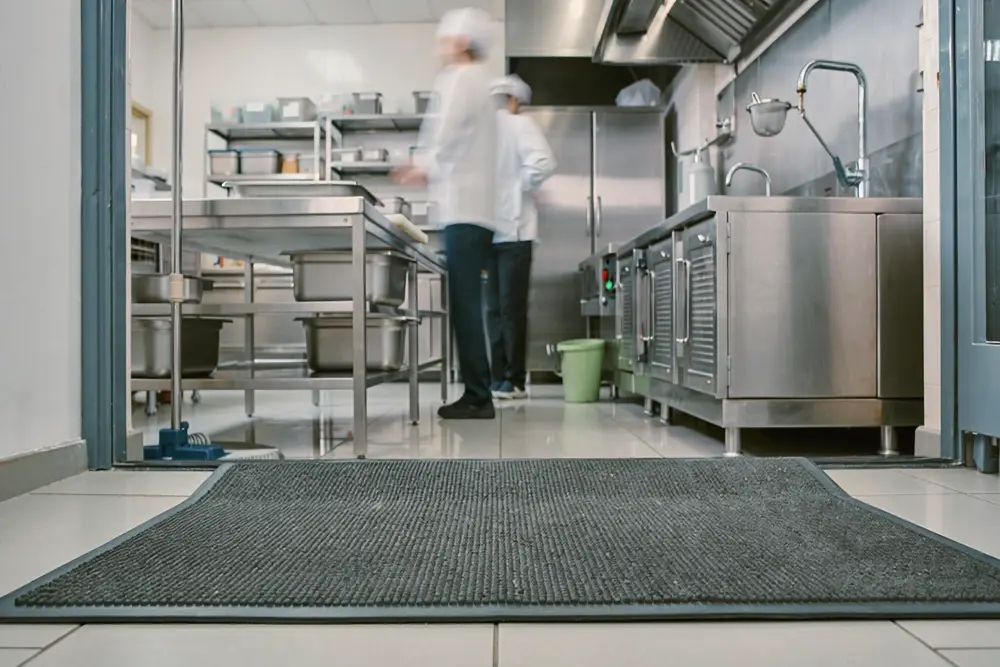
Food facilities invest significantly in internal hygiene controls. Surface sanitation schedules, zoned workwear programs, validated cleaning protocols, and pest management plans all receive careful attention during HACCP plan development. Entrance hygiene frequently receives far less.
The floor at a facility entry point is one of the highest-contamination surfaces in any food production environment. Every delivery, every staff entry, every equipment movement carries external contamination across that threshold. Without a structured, documented entrance hygiene system, this contamination travels directly into production areas - creating an uncontrolled pathway that undermines the internal controls built around it.
Cleantex provides commercial floor mat rental programs for food processing facilities and commercial kitchens across Perth. These programs capture entrance contamination, support HACCP documentation requirements, and integrate into the facility's broader food safety management system.
Why Entrance Hygiene Is a HACCP Consideration
The HACCP framework requires food businesses to identify and control contamination at every point in the production process. Most hazard analyses focus on food contact surfaces, workwear, water quality, and processing equipment. Entrance and transition zone flooring is less consistently addressed - and this gap creates real compliance risk.
Footwear carries significant contamination loads into food facilities. Research into floor microbiological contamination in commercial food environments consistently identifies entry points as primary contamination introduction sites. Pathogens including Listeria monocytogenes, Salmonella, and E. coli have been identified on facility floor surfaces near entry points. Evidence shows transfer to food production areas on footwear and equipment wheels.
Food Standards Australia New Zealand (FSANZ) requires food businesses to identify and control all significant contamination hazards. Where entrance contamination represents a credible pathway to food contact surfaces, it qualifies as a HACCP control point requiring documented management. Commercial floor mat rental programs that include validated service cycles and documented exchange records provide the evidence trail that demonstrates this control is actively managed.
The consequences of failing to control entrance contamination are significant. Regulatory audits under FSANZ food safety standards can identify inadequate entrance hygiene as a compliance failure. Retailer-initiated food safety assessments - including SQF, BRC, and FSSC 22000 audits - examine facility hygiene comprehensively. An unmanaged entrance zone creates a documented gap that can delay or prevent certification. For businesses managing food processing solutions across multiple certification frameworks, entrance hygiene documentation is not optional.
How Contaminated Floors Create Food Safety Risks
Floor contamination in food facilities follows predictable pathways that HACCP analysis can identify and control. Understanding these pathways clarifies why entrance matting solutions are a food safety tool rather than simply a cleanliness measure.
Footwear and Equipment Wheel Transfer
Staff entering from car parks, loading docks, and external areas carry contamination on footwear from soil, water, organic matter, and microbial loads in outdoor environments. Delivery personnel, contractors, and visitors who are not subject to the same hygiene protocols as production staff represent additional entry-point contamination sources.
Equipment wheels - forklifts, pallet jacks, trolleys, and wheeled bins - carry floor contamination across the facility with every movement. A single forklift making multiple trips between a loading dock and a production area distributes contamination across a significant floor surface area. Without capture at the transition point, this distribution continues uncontrolled throughout the working day.
Zone-to-Zone Contamination Transfer
Within food facilities, contamination transfer between hygiene zones is a critical HACCP concern. Raw material handling areas, ready-to-eat zones, and high-care production areas carry different contamination profiles. Entrance matting solutions at zone transition points - not only at external entry points - capture contamination before it crosses zone boundaries on footwear.
Commercial floor mat rental programs for food facilities include zone-specific mat placement planning. Entry mats at external access points address external contamination. Transition mats at internal zone boundaries address cross-zone transfer. Each mat position is serviced on a schedule appropriate to the contamination load at that location.
HACCP Documentation and Validation Requirements
Documenting entrance hygiene as a managed control requires evidence that the management system is functional, consistent, and regularly verified. This is where unmanaged entrance matting consistently fails HACCP audits - the physical mat may be present, but there is no evidence it is managed to a standard that provides reliable contamination control.
Service Validation and Exchange Records
Commercial floor mat rental programs generate service records that document each collection, laundering cycle, and exchange event. These records confirm that mats are serviced at defined intervals, that laundering meets specified standards, and that worn or damaged mats are replaced before they cease to function effectively.
For food facilities managing HACCP floor contamination control documentation, these service records provide the audit evidence that demonstrates the entrance hygiene control is functioning. Auditors assessing whether a HACCP plan is implemented as documented can verify mat service frequency, condition, and replacement history through provider records.
Facilities that purchase entrance mats and manage laundering in-house typically cannot produce equivalent documentation. In-house laundering lacks the process validation and systematic record-keeping that managed programs provide. This documentation gap is identifiable and challengeable during formal HACCP audits.
Mat Specifications for Food Environments
Not all floor mats are appropriate for food facility entrance hygiene applications. Food facility entrance hygiene in Perth requires mats manufactured from materials that do not support microbial growth, can be laundered to validated hygiene standards, and do not introduce physical contaminants through fibre shedding or deterioration.
Commercial floor mat rental programs specify mat materials and constructions appropriate for food production environments. Programs also account for the specific contamination types present at each entry location - moisture capture at washdown areas, dust and particulate capture at dry goods entries, and heavy soiling capture at loading dock access points.
Zone-Specific Mat Placement Strategy
Effective HACCP entrance hygiene management requires mat placement based on contamination pathway analysis rather than convenience or aesthetics. A structured approach to mat positioning creates a layered contamination capture system across the facility.
External entry points - main staff entries, loading docks, contractor access points, and delivery areas - represent the primary contamination introduction pathway. Mats at these locations should be sized to ensure multiple footsteps contact the mat surface before entering the facility. Single-step mats at wide entry points leave significant floor area unprotected.
Internal transition points between hygiene zones require mat placement calibrated to the specific cross-contamination risk at each boundary. High-care production areas, allergen-controlled zones, and ready-to-eat preparation areas all benefit from dedicated mat barriers that capture contamination before zone entry.
Managed floor mat rental programs include placement consultation as part of the service setup. Cleantex works with food facility managers to map contamination pathways and identify optimal mat positions - ensuring the program addresses the actual contamination risk profile rather than simply placing mats at obvious locations.
Laundering Standards and Service Frequency
The hygiene value of an entrance mat depends entirely on the quality and frequency of its laundering. A mat that is never serviced progressively accumulates contamination until it redistributes the pathogens it was placed to capture. In a food production environment, this transition from contamination barrier to contamination source can occur within days of deployment without adequate service.
Industrial laundering through a managed floor mat rental program processes mats using validated wash temperatures, approved chemical formulations, and documented cycle parameters. This process inactivates biological contamination and removes physical soiling to a standard that in-house laundering cannot consistently achieve.
Service frequency is calibrated to the contamination load at each mat position. High-traffic entry points in active food production facilities may require more frequent service than lower-traffic locations. Service schedules are structured around the operational requirements of each facility - ensuring mat effectiveness is maintained throughout the production week, not only at the start of each service cycle.
Workwear and Linen Programs as a Complementary Contamination Layer
Entrance matting addresses floor-level contamination. Workwear and linen programs address garment-level contamination. Together, these management systems create a layered contamination defence that is more effective than either element deployed independently.
Workwear rental programs for food environments include food-appropriate garments managed through validated laundering cycles - ensuring that staff entering production areas are not themselves a contamination introduction pathway. Linen rental services that include food-appropriate aprons, surface cloths, and protective textiles extend the contamination control framework from floor surfaces to food contact surfaces and food handling garments.
Managed laundering of both floor mats and food-contact linen through a single provider creates a consistent hygiene documentation record across multiple contamination control elements. When entrance matting solutions capture external contamination at entry points and zone boundaries, and zoned workwear programs prevent contamination transfer through garments, the facility's HACCP contamination control system addresses all primary introduction and transfer pathways in a coordinated, documented way. This integrated approach is what food safety auditors look for when assessing whether a HACCP plan is genuinely implemented rather than merely documented.
The Operational Case for Commercial Floor Mat Rental Programs
Managing entrance matting in-house requires purchasing mats, establishing a laundering process, maintaining a replacement budget, and tracking mat condition across multiple positions throughout the facility. For food processing operations already managing complex production and compliance demands, this administrative overhead competes with higher-priority operational responsibilities.
Commercial floor mat rental programs remove all of this burden from the facility team. Mats are supplied, serviced, and replaced by the provider. The facility receives documented service records without managing the laundering process. Mat condition is assessed at each exchange, and replacements are made before deterioration creates a compliance risk.
The fixed cost structure of a managed program also simplifies budget planning. There are no unexpected mat replacement costs, no laundering equipment maintenance expenses, and no seasonal cost variations from servicing demand changes. Food processing facilities across Perth can budget for entrance hygiene management with the same predictability applied to other managed services. SWS Group structures these programs to align with each facility's operational schedule and compliance requirements.
Integrating Floor Mat Management with Broader Food Facility Hygiene
Entrance hygiene is most effective when managed as part of a comprehensive food facility hygiene strategy. Commercial cleaning services for food environments address surface sanitation, cold room hygiene, and production area cleaning alongside the entrance hygiene management that floor mat programs provide. SWS Group delivers both Cleantex mat programs and Cleanpro cleaning services, giving food facilities access to coordinated, documented hygiene management across all primary contamination control areas.
Integrated management of floor mats, linen, workwear, and facility cleaning through a single provider creates a more coherent HACCP documentation record than managing each element through separate providers with different service standards and documentation formats.
Conclusion
Commercial floor mat rental programs are a documented HACCP control for Perth food processing and catering facilities - capturing entrance contamination, generating audit-ready service records, and integrating into the facility's broader food safety management system.
To discuss floor mat rental options for a food facility, arrange a consultation with the Cleantex team, or call (08) 9336 6944 directly.