












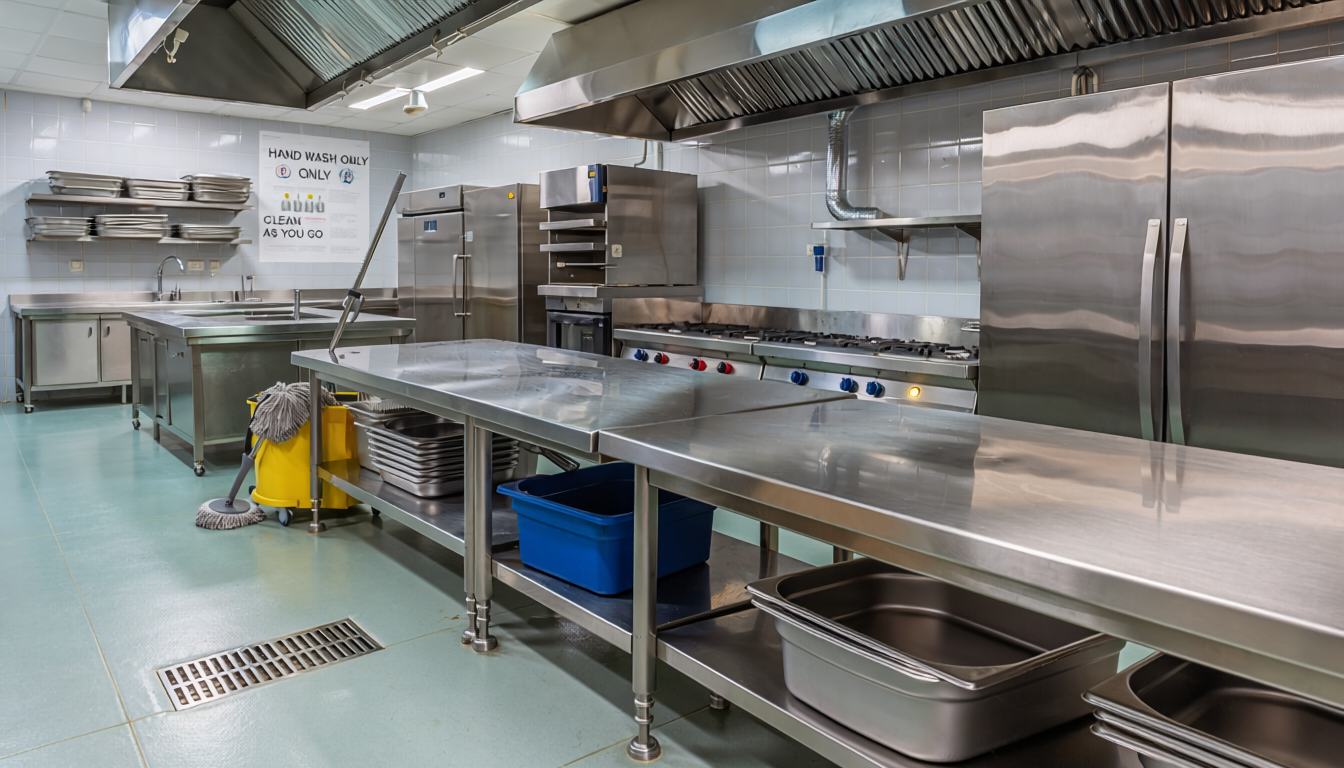
Commercial kitchens generate contamination at a rate that makes them among the most demanding cleaning environments in any industry. Grease, organic matter, biological contamination from raw produce and proteins, chemical residues from cleaning agents, and the thermal cycling of cooking and cooling surfaces all create a hygiene challenge that standard commercial cleaning protocols cannot adequately address.
Industrial kitchen cleaning compliance for Perth operators involves more than wiping down surfaces at the end of service. It requires a structured, documented cleaning program that addresses both the routine maintenance of food contact surfaces throughout the operating day and the deep cleaning of infrastructure - exhaust hoods, grease traps, equipment interiors, and drain systems - that accumulates contamination beyond the reach of daily cleaning methods.
Through Cleanpro, Perth food businesses access specialist kitchen cleaning programs that meet food safety cleaning standards, generate HACCP documentation, and address both routine and deep cleaning requirements within a managed, scheduled service framework that regulatory auditors can verify.
Why Industrial Kitchens Require Specialist Cleaning
The contamination profile of an industrial kitchen is categorically different from a standard commercial environment. Fat, oil, and grease accumulation on surfaces, in exhaust systems, and in drain infrastructure creates fire risks alongside hygiene risks. These are not theoretical risks - grease fires in commercial kitchens are among the most common causes of serious premises fires in the hospitality sector, and inadequately cleaned exhaust systems are a primary contributing factor.
For hospitality venues and food businesses that also require broader commercial cleaning services across dining rooms, function spaces, and customer amenity areas, Cleanpro delivers kitchen and front-of-house cleaning under a single managed program - creating a consistent hygiene standard across the entire facility rather than a split between specialist kitchen cleaning and general venue cleaning.
Protein-based contamination from raw meat, seafood, and dairy requires cleaning chemistry and contact times different from the products used for standard surface cleaning. Protein residues that are inadequately removed provide a nutrient-rich growth substrate for Salmonella, Listeria, and E. coli - pathogens that cause foodborne illness outbreaks with direct consequences for the affected business including regulatory shutdown, litigation, and reputational damage that can be terminal for a hospitality operation.
Temperature cycling in commercial kitchens - surfaces that reach high temperatures during service and cool during cleaning periods - affects the efficacy of cleaning chemistry in ways that require specific product selection and application timing. Cleaning products applied to still-hot surfaces may not achieve their specified contact times before volatilising or being degraded by heat. Products applied before surfaces have cooled sufficiently may not achieve the biocidal efficacy expected at standard temperatures.
Commercial kitchen cleaning in Perth operations that applies standard commercial cleaning products and methods to industrial kitchen environments will systematically underperform against food safety cleaning standards - creating compliance gaps that are identifiable during food safety audits and inspections, and that can result in failed assessments, prohibition notices, and public disclosure of non-compliance through published inspection outcomes.
FSANZ Requirements and HACCP Kitchen Cleaning Controls
Food Standards Australia New Zealand Standard 3.2.2 requires food businesses to maintain food premises and equipment in a clean condition and in good repair. The standard specifies that food contact surfaces must be cleaned and, where necessary, sanitised. It also requires that cleaning is conducted in a manner that does not itself contaminate food or food contact surfaces.
Cleaning as a Documented HACCP Prerequisite Program
In HACCP food safety plans, cleaning and sanitation of food contact surfaces is identified as a Prerequisite Program - a foundational hygiene control that underpins the entire HACCP system. HACCP kitchen cleaning requirements include documented cleaning schedules that specify the surface or equipment to be cleaned, the cleaning method, the cleaning product to be used, the concentration and contact time required, the frequency of cleaning, and the responsibility for each cleaning task. Hotels and function venues managing kitchen hygiene as part of broader accommodation industry solutions face the same FSANZ documentation obligations as stand-alone food businesses - with the added complexity of managing multiple kitchen environments and catering formats under a single HACCP plan.
Documentation is non-negotiable. Food safety auditors assessing HACCP compliance do not accept verbal assurances that cleaning is performed adequately. They review written cleaning schedules, completion records, corrective action logs when non-compliances are identified, and verification records that confirm the cleaning program is functioning as intended. Industrial kitchen cleaning compliance for Perth businesses operating under HACCP plans requires a documentation infrastructure that most in-house cleaning programs do not maintain to the required standard.
The consequences of HACCP kitchen cleaning documentation failures extend well beyond audit findings. In the event of a foodborne illness outbreak linked to a facility, the absence of documented cleaning records significantly worsens the regulatory and legal position of the food business. Operators who cannot demonstrate that cleaning was performed in accordance with their HACCP plan face presumptions of negligence that are difficult to rebut without documentary evidence.
Routine vs Deep Cleaning: The Two-Tier Program Structure
Compliant industrial kitchen cleaning operates on two tiers that address different contamination accumulation timescales. Routine cleaning addresses immediate service-period contamination. Deep cleaning addresses infrastructure-level contamination that accumulates over days, weeks, and months beyond the reach of daily programs.
Routine cleaning addresses food contact surfaces - benches, cutting boards, equipment surfaces, utensils, and service equipment - at defined frequencies throughout the service period and comprehensively at end of service. Routine cleaning removes visible contamination, applies sanitiser to food contact surfaces, and restores working surfaces to a standard appropriate for the next service period.
Entry points to kitchen areas also contribute to the overall contamination load that food safety programs must manage. Floor mat rental programs at kitchen entry points capture external contamination from footwear before it reaches food preparation floor surfaces - reducing the contamination introduced from outside the kitchen environment and complementing the internal cleaning program that addresses contamination generated within the kitchen itself. In a busy kitchen operating across multiple services per day, this routine cleaning must be embedded in the operational workflow rather than deferred to end-of-day - with handwashing, surface wipe-down between tasks, and zone-specific utensil management all forming part of the cleaning system.
Deep cleaning addresses kitchen infrastructure that accumulates contamination over time and beyond the reach of daily surface cleaning. Exhaust canopies and ductwork accumulate grease at rates that create fire risks and contamination pathways that routine cleaning cannot address. Equipment interiors - ovens, fryers, bain-maries, cold room components, and refrigeration units - require periodic deep cleaning beyond the surface-level cleaning that daily protocols deliver. Drain systems and grease traps accumulate organic matter and grease that must be removed to prevent odour, drain obstruction, pest attraction, and potential environmental discharge compliance issues under the Environmental Protection Act 1986 (WA).
Grease Trap, Exhaust Hood, and Equipment Deep Cleaning
Grease trap maintenance is both a food safety and an environmental compliance requirement. Grease traps that are not serviced at appropriate frequencies overflow, create drainage problems in kitchen floor areas, and may violate environmental discharge regulations under the Environmental Protection Act 1986 (WA). Scheduled professional servicing is essential for commercial kitchens with grease trap installations - and service records demonstrating appropriate maintenance frequency are required for compliance with both food safety and environmental obligations.
Exhaust hood and ductwork cleaning is a fire safety as well as a food safety requirement. The Building Code of Australia and Australian Standard AS 1851 reference cleaning frequencies for commercial kitchen exhaust systems based on cooking volume, fuel type, and grease loading. Facilities that do not maintain exhaust system cleaning records face insurance compliance issues - many commercial property and contents policies specifically require demonstrated exhaust system maintenance - alongside the direct fire safety risks that accumulated grease in ductwork creates.
SWS Group delivers comprehensive industrial kitchen cleaning compliance programs through Cleanpro - covering both routine and deep cleaning tiers, grease trap servicing, and exhaust system cleaning within a scheduled, documented service program that supports HACCP documentation requirements and satisfies the record-keeping obligations of food safety assessments.
Chemical Selection for Food-Contact Surface Cleaning
Chemical selection for industrial kitchen cleaning must address both cleaning efficacy and food safety - products used on food contact surfaces must either be safe for incidental food contact after appropriate rinsing, or be specifically formulated and verified as no-rinse safe at the concentrations applied. Using products that are not food contact-safe on food contact surfaces is a food safety non-compliance regardless of their cleaning performance.
Food safety cleaning standards distinguish clearly between cleaning - removing visible contamination and organic residue from surfaces - and sanitising - reducing the microbial population on a clean surface to safe levels. Both steps are required for food contact surfaces, and they must occur in the correct order. Applying a sanitiser to a visibly contaminated surface does not achieve sanitisation - the organic contamination inhibits the sanitiser's biocidal efficacy. The cleaning step must precede and be completed before sanitisation for the two-step process to function as designed.
Chemical management in commercial kitchen environments also addresses worker safety. Many kitchen cleaning chemicals - particularly concentrated degreasers, caustic cleaners, and acidic scale removers - are hazardous substances under WHS regulations. Safety data sheets must be available in the workplace, storage and dilution must follow specified procedures, and PPE requirements must be met by staff applying these products. Managed cleaning programs through Cleanpro include chemical safety management as a component of the service. Kitchens with adjoining food service and customer amenity areas can also extend hygiene management into those spaces through washroom hygiene solutions - ensuring that front-of-house washroom standards match the food safety hygiene standards maintained in the kitchen itself.
Linen and Workwear as Complementary Kitchen Hygiene Controls
Kitchen cleaning programs address surfaces and infrastructure. Garment and linen hygiene controls address the contamination carried by kitchen staff and the textiles used in food contact and food handling activities - a parallel and equally important dimension of the food safety hygiene system.
Linen rental services for commercial kitchen environments supply chef's cloths, aprons, oven cloths, service linen, and other textiles used in food handling with validated industrial laundering that meets food safety standards. Managed linen programs ensure that food-contact textiles are laundered to documented standards rather than through unvalidated in-house processes that create HACCP compliance gaps. In-house laundering of kitchen linen rarely achieves the wash temperatures and chemical formulations necessary to meet the laundering standards that food safety hygiene requires.
Workwear rental programs for kitchen staff supply chef's uniforms, aprons, and food handling garments that are collected, industrially laundered, and returned to service on scheduled exchange cycles. Staff who launder their own kitchen workwear at home expose food preparation areas to the risk of garments that are returned to service carrying residual contamination from home laundering - a documented source of food safety non-compliance in facilities relying on self-managed garment hygiene.
For Perth food businesses seeking food processing solutions that integrate kitchen cleaning, linen management, and workwear programs under a single provider, SWS Group delivers coordinated hygiene management through Cleanpro and Cleantex - with consistent documentation standards across all hygiene control elements and a single point of contact for the complete food safety hygiene program.
Conclusion
Industrial kitchen cleaning compliance for Perth operators requires a structured two-tier program, validated chemical selection, documented HACCP records, and specialist cleaning capability that general commercial providers cannot deliver. Cleanpro's food environment cleaning programs address all compliance dimensions within a single managed service relationship.
To discuss industrial kitchen cleaning programs for a Perth food business, call (08) 9336 6944 for a facility assessment. To arrange a consultation with the Cleanpro team, contact the team to outline kitchen scope, cleaning frequencies, and compliance requirements.