













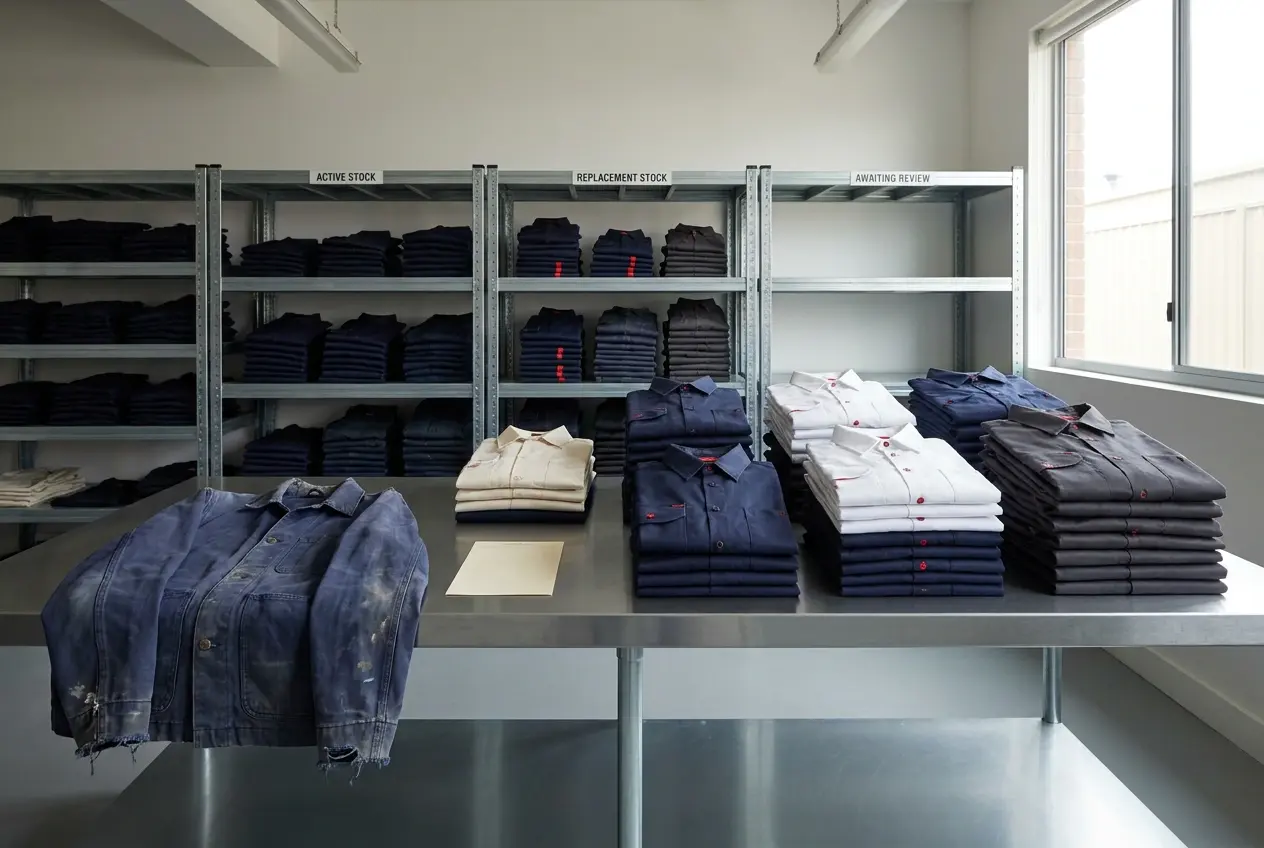
A team can begin with well-chosen uniforms and still develop an uneven appearance as garments move through daily use. Replacing everything on a fixed date can remove garments that remain usable, while waiting for individual complaints can leave obvious exceptions in circulation.
A managed replacement programme gives workplaces a repeatable way to act when a garment no longer meets its condition standard. Observable triggers and a recorded outcome connect each decision to the wearer, allocation and role, keeping the working uniform pool current instead of simply adding another item.
The aim is consistent presentation decisions across teams. A visible hold route and an accurate final status keep uncertain garments out of normal issue locations until they are repaired, replaced or returned to use.
Define the presentation standard in observable terms
Replacement decisions become inconsistent when the only instruction is to keep uniforms looking professional. A better standard groups the observable signs that matter for each garment type, including condition, fastener function, branding and the way the item presents against the current uniform set.
- Permanent staining or fading that is visibly different from the active uniform set.
- Holes, open seams, missing buttons or fasteners that no longer work as intended.
- Damaged, incorrect or outdated branding that disrupts the approved team presentation.
The standard should reflect where and how the garment is worn. A customer-facing polo may have a different presentation threshold from an outer layer used mainly in a work area, even when both remain part of the same uniform system. That distinction is about the organisation's chosen image, not a universal judgement about garment quality.
Examples give staff, supervisors and the workwear coordinator enough shared language to recognise when an item should leave routine circulation for a decision.
Report and hold uncertain garments
Wearers often notice a problem first, but they need to know what to do with that observation. Give them one reporting route and ask for a small set of useful details: their name or wearer number, garment type, the condition observed and where the item has been placed.
Supervisors can raise issues noticed during normal work, while the coordinator checks the allocation and decides the next step. The route should not depend on informal reminders or public scrutiny of individual employees.
A garment awaiting a decision should not remain mixed with normal clean or used stock. Give it a visible hold status and a separate location. The marker should connect the item to the wearer and request without relying on a loose note that can become detached. This small control prevents an item from being collected, cleaned and returned before anyone has addressed the reported condition.
Review held items at an agreed interval and assign each one a clear next decision so the separate area does not become long-term storage. If replacement handling sits within Cleantex's workwear rental service, use the agreed collection and return route while the organisation retains its own approval standard.
Record the decision against the garment and wearer
Keep one concise replacement record: wearer, garment category, size, reported condition, date, decision, new issue and the old item's final status. That is enough to connect withdrawal and issue without turning the process into an administrative burden.
A connected record prevents duplicate requests and unexplained stock growth, such as a new garment being issued while the old item remains active in the allocation.
Review records for useful patterns, such as repeated damage to one garment type or recurring branding problems. Check the circumstances before changing garment selection or handling arrangements.
Separate repair, replacement and presentation decisions
Not every condition issue has the same answer. A permitted repair may restore an item, a replacement may be appropriate, or the garment may remain acceptable under the organisation's standard. A technically possible repair is not automatically the right presentation choice if it leaves a conspicuous result, and a minor cosmetic variation is not automatically a reason to discard an otherwise serviceable item.
Set authority for each decision. Routine replacements within an agreed trigger may be handled by the coordinator, while unusual or repeated cases can go to a manager or account contact. Where a garment carries special workplace requirements, the responsible employer must determine whether repair or continued use is appropriate.
Document any approved repair route and check the returned result before release. If a decision cannot be made because information is missing, retain the hold rather than allowing urgency to return the item.
Keep replacement stock aligned with real allocations
Replacement planning works better when the organisation knows what each role and wearer is meant to hold. Start with the active allocation by garment type and quantity, then define whether a replacement is drawn from reserve stock, requested individually or supplied through the service arrangement.
Reserve quantities should reflect actual replacement experience and lead times rather than an arbitrary percentage. Too little reserve can delay a straightforward exchange, while too much can leave outdated sizes or branded stock after the workforce changes. Where ownership is the better fit, the direct purchase workwear option can sit alongside rental for selected categories. Keep emergency additions separate from permanent changes to a wearer's normal allocation.
Manage branding changes without creating mixed sets
A logo, colour or garment-style change can quickly create visible inconsistency if it is handled as a series of isolated replacements. Decide whether old and new versions may be worn together during a defined transition or whether a coordinated issue date is required.
Before approving a new presentation version, count the affected active and reserve garments. If the update uses a new logo treatment or garment design, custom workwear and personalisation options are relevant to the specification. Set an effective version, identify the affected garments and define when old branding leaves ordinary issue.
Code later replacements by the approved presentation version as well as garment type. Once an old version is closed, remove it from ordinary issue locations and update the active standard. This keeps every issued garment tied to the current branding specification.
Review patterns without turning replacement into a quota
A useful review looks at the reasons, timing and garment categories behind replacements. A growing team may naturally require more exchanges, while a stable total may conceal repeated problems affecting the same role. Compare replacement activity with active wearer numbers, role changes and any uniform updates before drawing conclusions.
Look for clusters that deserve a closer check: the same defect, one garment category being exchanged repeatedly, marks associated with a particular task, or items held for too long. Speak with wearers and supervisors to understand the circumstances. The next action might involve garment selection, handling, stock allocation or clearer reporting rather than a stricter replacement limit.
Avoid quotas that discourage legitimate condition reports. Review should identify useful changes to selection, handling, allocation or the reporting route, not simply make replacement totals look low.
A repeatable rhythm combines prompt exception handling with periodic reconciliation. Wearers report observable issues, uncertain garments enter hold, authorised decisions update the allocation and supervisors confirm relevant wearer changes.
Use less frequent reviews for patterns, branding plans and garment-category changes. Keep immediate replacement decisions moving rather than waiting for a broader meeting.
Managed replacement supports a consistent team presentation by applying the same observable standard to each condition decision, separating held items from normal circulation and aligning every approved issue with the current branding version.
Review recurring patterns without imposing a blind replacement quota. Use the findings to clarify the condition standard, repair route, stock decision or branding specification for the next ongoing cycle.
Keep the active standard beside the reporting route so supervisors and coordinators work from the same version. This small reference point reduces avoidable debate when a garment enters hold and keeps the decision focused on its current condition and presentation.