













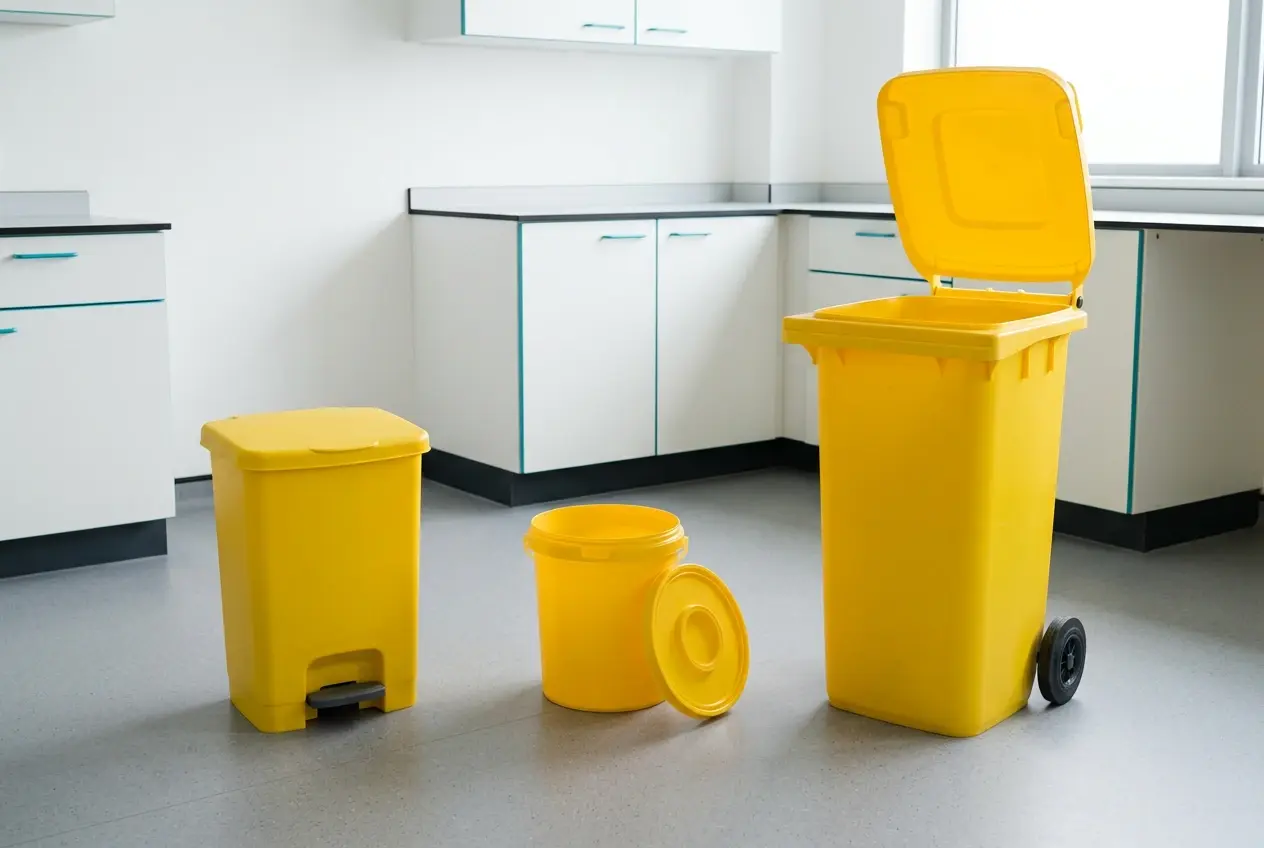
Clinical waste container formats differ in how they receive waste, open during use and connect to collection. A pedal bin provides foot-operated lid access. A single-use pail provides a container that is closed and replaced rather than reused. A larger outer bin can accommodate an agreed containment arrangement at a collection point. Start with the facility’s assessed waste stream, then compare these physical roles. The biggest container is not necessarily the most workable choice.
Think of the choice as two connected decisions: what receives the waste where it arises, and what is presented for collection. Those may involve the same container or different compatible components. A treatment room might need convenient pedal access, while its collection arrangement uses a separate outer bin. Another location might suit a single-use pail. Comparing the complete arrangement prevents a convenient opening from disguising an awkward replacement or collection step.
Match the Waste Stream and Disposal Point
Choose a container for the materials the facility has assessed and the collection accepts. Waste from a first-aid area or treatment room is not automatically clinical waste. Keep general waste and distinct hazardous streams in their assigned routes. Sharps require an appropriate purpose-designed rigid container, not a soft-waste pedal bin. Neither a rigid-looking pail nor the word “bagless” establishes suitability for needles or other sharp objects.
WA Health’s clinical waste Code calls for segregation at the time and place waste is generated and distinguishes non-sharp waste bags from rigid-walled sharps containers. Its specific scope covers WA Health personnel and contractors, with broader application through the general public health duty. For container selection, the useful principle is to provide the right receptacle where the assessed waste arises. It is not a basis for assigning identical legal requirements to every private clinic.
Map the proposed disposal point against the room’s normal activity. Note the approach direction, nearby doors, work surfaces and cleaning access. A unit that fits beneath a bench may lack clearance for its lid. One beside a doorway may obstruct circulation when someone stands at it. Include the space needed to replace or collect the container, not just its closed footprint. These observations help narrow the format before committing to a particular size.
Compare Access, Closure and Container Roles
Pedal Bins for Foot-Operated Access
Hands-free clinical waste bins let users open the lid with a foot pedal rather than lifting it by hand. That access method is useful only if the pedal remains reachable in the intended position. Check whether a cabinet plinth, nearby equipment or the angle of approach interferes with operation. Allow enough space for the user to stand comfortably and for the lid to travel fully. A narrow recess can defeat the access benefit even when the bin fits inside.
Our 45-litre pedal bin has a sturdy pedal operation, an easy-open lid and a flexible polypropylene body with chemical and stain resistance. When comparing it with another option, match those features to the proposed location and cleaning procedure. Chemical resistance does not establish compatibility with every disinfectant, concentration or contact time. Use the applicable product cleaning instructions rather than assuming the body can undergo sterilisation. The nominal capacity also needs checking against the container’s actual dimensions.
Separate the opening mechanism from the containment system. “Pedal-operated” describes lid access; “bagless” describes an arrangement without a bag. These descriptions need not identify mutually exclusive products. Establish whether the selected unit requires a compatible liner, an inner container or another specified component. If a liner is required, its fit must not obstruct the lid. If the arrangement is bagless, identify what receives the contents and what is exchanged at collection.
Single-Use Pails for Whole-Container Replacement
A single-use pail changes the replacement decision: the container is closed for its agreed disposal route and replaced with an unused unit. Compare its opening, supplied lid and final closure method together. A lid used during filling may perform a different role from the final closure. Understand that distinction before selecting the pail. Do not assume every lid can be reopened after final closure or that an unfamiliar replacement lid is compatible.
A pail’s shape and rigid walls do not establish a liquid rating, tamper resistance or permission to stack filled units. Those properties need confirmation for the actual product and intended contents. For placement, consider the pail’s height and opening rather than assuming a compact container belongs on a worktop. The chosen position should support its intended use without taking over a clean preparation area or requiring an awkward reach.
Plan space for the next unused pail as well as the one in service. Whole-container replacement requires an available compatible replacement when the current unit leaves use. Check whether lids arrive attached or separately and where unused components will be kept. Include the closed pail’s agreed destination in the layout assessment. A compact disposal point offers little practical benefit if replacement stock blocks the surrounding space or the collection arrangement cannot receive the closed unit.
Larger Outer Bins for the Collection Arrangement
A larger outer bin may have a different job from the receptacle used during a treatment task. It can form part of the agreed collection arrangement for compatible contained waste. Establish whether the proposed bin receives waste directly or holds specified inner containers. These roles are not interchangeable. The answer determines which opening dimensions matter and whether the complete contained unit fits. Assess that arrangement without planning to reopen, empty or manually transfer waste between containers.
Do not infer reusability from size. If the selected outer bin is reusable, establish who exchanges or retains it and who performs its required cleaning. A reusable outer container and a single-use inner container can have different responsibilities within one arrangement. Keep those responsibilities attached to the correct component. Closing the outer lid does not replace the inner container’s specified closure, and replacing an inner unit does not establish that the outer bin needs no cleaning.
Where a larger bin has wheels, check the route as well as its parking position. Door widths, thresholds, corners and changes in floor level affect whether the proposed movement is practical. Include handles and lid projections when considering clearance. Wheels do not establish that every route or load is suitable. For a non-mobile unit, resolve its assessed movement method before selection rather than assuming staff can carry it because the empty container feels light.
Balance Capacity With Dimensions and Contents
Capacity measures volume; dimensions describe the space a container occupies. Two units with similar capacities can have different heights, opening shapes and floor footprints. Compare width, depth and height with the proposed location, then add lid and user clearance. For an outer bin, check the space occupied by the intended closed inner containers. Their shapes may leave gaps, so nominal outer volume does not translate directly into an equivalent number of smaller units.
Expected contents affect useful capacity. Bulky, lightweight material can occupy available space quickly, while denser accepted contents may reach an approved weight limit with space remaining. Compare the applicable volume and weight limits separately; do not derive one from the other. Where both apply, the first limit reached governs use. Neither a larger container nor apparent spare space justifies compacting contents. Use existing waste records or the facility’s assessment rather than testing capacity with actual waste.
Relate the chosen capacity to the collection arrangement already being assessed. If a point-of-use container needs frequent replacement, examine whether the issue is insufficient usable capacity or unsuitable placement. A larger unit might address the first problem but worsen the second. Leave room for the agreed replacement activity and any temporary overlap between outgoing and incoming units. Choose capacity and collection together without assuming a particular litre figure guarantees a suitable interval.
Check the Empty Set-Up and Collection Handover
Walk Through the Proposed Position
Use a clean, empty demonstration unit to check the proposed position, following its instructions. Observe the approach, pedal access where present, lid travel and clearance beside nearby fittings. Include any required compatible liner or lid in that assessment. Open nearby room doors and consider normal equipment positions. This walkthrough tests the layout and component interaction; it does not prove loaded handling performance, chemical compatibility or suitability for an unapproved waste stream.
Record the specific obstacle if the demonstration exposes one. A lid striking a bench needs a clearance solution; a pedal hidden behind equipment needs an access solution. Changing capacity alone may solve neither. For a single-use pail, review final closure through the instructions or a designated demonstration sample. Do not irreversibly close stock intended for use merely to test it. Keep all demonstrations free of waste and leave actual handling to the assessed workplace procedure.
Agree What Is Collected and Replaced
For Perth metro premises, we can discuss medical waste solutions against the assessed contents, available space and proposed container format. Our medical-bin service excludes anatomical, cytotoxic, pharmaceutical and laparoscopic waste. Confirm separate arrangements for those streams. For the selected service, agree which component is collected, which is replaced and who supplies required consumables. Include access to the collection point and responsibility for reusable-container cleaning. This connects the format choice to a workable handover rather than an undefined order for a “medical bin”.
Conclusion
Choose clinical waste container formats by matching the assessed stream to the disposal point and collection arrangement. Pedal access addresses lid operation, single-use pails address whole-container replacement, and larger outer bins address a different containment role. Compare dimensions, usable capacity, approved weight limits and required components before selecting a unit. A clean, empty walkthrough can expose practical mismatches early. Bring the assessed contents and available space to a discussion with us about our Perth metro medical-bin service, so the container choice fits the agreed collection arrangement. Confirm acceptance first; our medical-bin service excludes anatomical, cytotoxic, pharmaceutical and laparoscopic waste.