













Cross-contamination in food processing, healthcare, and commercial environments doesn't just risk compliance failures, it threatens business operations, public health, and brand reputation. A single contamination event can trigger product recalls, regulatory penalties, and permanent customer loss. Yet many facilities overlook one of the most mobile contamination vectors: staff uniforms moving between zones, shifts, and external environments.
The challenge intensifies when uniforms laundered at home or through non-compliant services carry pathogens, allergens, and chemical residues between production zones. Without controlled processing systems, garments become contamination highways rather than protective equipment supporting food safety protocols.
Understanding how managed uniform programs address cross-contamination risks helps food facility managers implement comprehensive contamination control strategies that leverage professional laundering expertise.
How Uniforms Become Contamination Vectors
Staff uniforms contact raw materials, work surfaces, equipment, and external environments throughout shifts. Without controlled laundering protocols, these garments carry bacteria, allergens, and chemical residues between production zones, storage areas, and food contact surfaces.
Research published in the International Journal of Food Microbiology demonstrates that inadequately laundered food industry uniforms harbour Listeria monocytogenes, Salmonella, and E. coli even after home washing. Standard domestic machines operate at 40–60°C, insufficient to eliminate heat-resistant pathogens. Detergent selection, wash duration, and drying methods vary by individual, creating inconsistent hygiene outcomes across teams.
The contamination risk compounds when staff wear uniforms to and from work sites. Garments contact public transport surfaces, personal vehicles, and home environments before entering food production areas. A 2022 study in Food Control journal found that 34% of food worker uniforms tested positive for faecal coliforms when laundered at home, compared to 0% for commercially processed garments.
Cross-contamination also occurs between facility zones. Staff moving from raw material handling to finished product areas without garment changes transfer microorganisms across the production flow. Allergen cross-contact presents particular risk, wheat proteins, dairy residues, and nut particles persist in fabric fibres through inadequate washing, threatening allergen-sensitive consumers.
Managed uniform programs address these pathways through controlled laundering, zone-specific garment systems, and documented hygiene protocols that eliminate variables inherent in purchase or home-laundering models.
Thermal Disinfection Standards for Food Industry Uniforms
Effective pathogen elimination requires sustained thermal exposure that denatures bacterial proteins and viral capsids. AS/NZS 4146 healthcare laundry standards specify 71°C for 3 minutes minimum, or equivalent time-temperature combinations achieving A₀ 600 disinfection value. These parameters eliminate vegetative bacteria, most viruses, and fungi whilst preserving fabric performance.
Commercial laundry systems achieve this through programmed wash cycles with temperature verification at multiple points. Industrial machines maintain precise water temperatures across rinse stages, unlike domestic washers where temperature fluctuates based on water supply and load size. The controlled environment ensures every garment receives identical thermal exposure regardless of load position or fabric density.
Chemical disinfection supplements thermal processing for specific applications. Oxygen-based bleaches eliminate organic staining whilst providing additional antimicrobial action. Enzymatic detergents break down protein and starch residues that harbour bacteria. pH-controlled rinses neutralise chemical residues that could contact food surfaces or cause skin irritation.
Drying protocols complete the disinfection cycle. Tumble drying at 80–85°C provides secondary pathogen reduction whilst eliminating moisture that supports microbial growth. Proper drying also prevents musty odours indicating bacterial proliferation in damp fabrics. Healthcare linen services apply identical standards to patient gowns and surgical linens, demonstrating the rigour required for infection control applications.
The thermal disinfection process documentation provides HACCP verification. Temperature logs, cycle completion records, and batch tracking demonstrate due diligence during health department inspections or third-party audits. This documentation proves uniform hygiene compliance in ways home laundering cannot replicate.
Colour-Coded Zoning Systems for Production Areas
Visual zoning prevents cross-contamination by designating specific garment colours to facility areas based on contamination risk. The system creates immediate visual identification of staff location compliance, a worker in raw material area uniforms (typically red or brown) becomes instantly visible if entering finished product zones requiring white or light blue garments.
Typical colour coding follows food safety risk hierarchies. High-risk finished product areas use white uniforms showing any contamination immediately. Medium-risk processing zones use light blue or green. Raw material handling areas use darker colours like navy or burgundy. External areas including loading docks and waste handling use black or brown garments clearly distinguishing them from production uniforms.
The colour system extends to accessories. Hairnets, aprons, and sleeve protectors match zone designations, preventing inadvertent cross-use. Some facilities implement colour-coded pockets or trim allowing base garment reuse across zones whilst changing high-contact elements between areas.
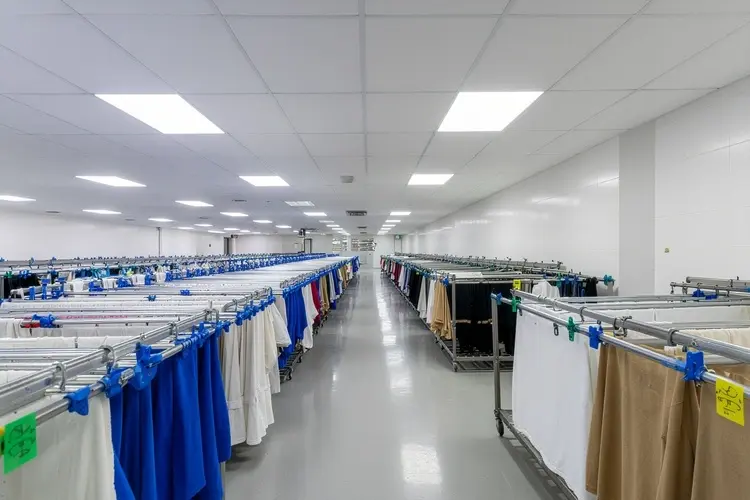
Managed uniform programs enforce zoning through controlled inventory. Each staff member receives zone-specific garments in quantities supporting shift patterns without cross-use. Soiled garments return to commercial laundry in colour-separated bags, preventing cross-contamination during collection and transport. Clean uniforms arrive pre-sorted by zone and employee, eliminating distribution errors.
Food and beverage services particularly benefit from zoning systems where raw and cooked products share facilities. A bakery processing both nut-containing and nut-free products uses colour coding to prevent allergen cross-contact through staff movement. Brewery operations separate packaging area uniforms from cellar operations to prevent contamination of finished product.
The visual compliance aspect supports training and supervision. New staff quickly learn zone restrictions through colour association. Supervisors identify compliance issues at a glance without checking credentials or asking questions. During audits, inspectors immediately verify zoning protocol implementation through observable garment use.
Inventory Management and Garment Lifecycle Tracking
Professional uniform management systems track individual garment lifecycles from deployment through retirement. Barcode or RFID tagging records wash cycles, repair history, and quality inspections for each piece. This data identifies garments reaching end-of-life before fabric degradation compromises hygiene performance or professional appearance.
Typical food industry uniforms withstand 100–150 commercial wash cycles before replacement. High-contact items like aprons or sleeve protectors may require replacement at 50–75 cycles. Tracking systems automatically flag garments approaching replacement thresholds, preventing continued use of degraded items that could harbour bacteria in damaged fibres or compromise thermal barrier properties.
Inventory management ensures adequate garment rotation supporting hygiene protocols. Each staff member requires minimum 3–5 uniform sets supporting daily changes without home storage. The rotation allows 24–48 hour commercial laundering turnaround whilst maintaining clean garment availability. Facilities operating multiple shifts or 24-hour production require deeper inventory supporting continuous garment exchange.
Automated replenishment prevents shortages compromising hygiene compliance. When garments reach retirement thresholds or damage requires removal, replacement items automatically enter the rotation maintaining consistent inventory levels. This eliminates the gap periods in purchase programs where staff wear degraded uniforms awaiting procurement approval and delivery.
Seasonal adjustments accommodate production volume fluctuations. Food processors increasing staff during harvest periods receive temporary inventory increases supporting the expanded workforce. When production normalises, excess inventory returns to the service provider without creating storage burdens or sunk costs in unused garments.
The tracking data also identifies unusual wear patterns indicating process issues. Excessive garment damage in specific areas may reveal equipment problems, workflow inefficiencies, or training gaps. A pattern of torn aprons in one production zone could indicate a sharp equipment edge requiring maintenance. Accelerated fabric degradation might reveal chemical exposure requiring PPE evaluation.
Integration With HACCP and Food Safety Programs
HACCP plans identify critical control points where contamination risks require monitoring and verification. Uniform hygiene constitutes a prerequisite program supporting overall food safety management. Managed uniform services provide the documentation and control measures HACCP requires for this prerequisite.
Service specifications define uniform change frequencies based on contamination risk. High-risk areas may require twice-daily changes. Processing zones might specify daily changes. Packaging areas could operate on alternate-day schedules. The documented frequencies become part of the facility's HACCP plan, with compliance verification through service delivery records.
Laundering process validation demonstrates pathogen elimination capability. Commercial laundries conduct microbiological testing confirming thermal disinfection effectiveness. These validation studies provide scientific evidence that laundering protocols achieve the pathogen reduction HACCP requires. Annual revalidation ensures continued process effectiveness as equipment ages or procedures evolve.
Corrective action protocols address hygiene failures. If commercial laundering equipment malfunctions, the service provider implements alternative processing maintaining thermal disinfection standards. If garment contamination occurs during transport or storage, affected items undergo re-processing before deployment. These protocols prevent contaminated uniforms entering production areas whilst documenting the response for HACCP records.
Traceability links specific garments to individual staff members and production dates. If a contamination event occurs, investigators can identify which uniforms were in affected areas, when they were laundered, and whether any processing anomalies occurred. This traceability supports root cause analysis and demonstrates due diligence during regulatory investigations.
Service Models and Implementation Considerations
Managed uniform programs operate on rental or lease models with service frequencies matching facility requirements. Weekly service suits most food processing operations, soiled garments collected, clean inventory delivered, and any damaged items replaced. High-volume facilities may require twice-weekly or daily service supporting continuous production schedules.
Implementation begins with facility assessment and risk analysis. Service providers evaluate production flows, zone designations, staff numbers, and shift patterns. This assessment determines garment quantities, style selections, and colour coding schemes supporting the facility's food safety objectives. The evaluation also identifies change room requirements, soiled garment storage needs, and collection logistics.
Garment selection balances hygiene performance with worker comfort and task requirements. Lightweight fabrics suit high-temperature environments like commercial kitchens. Heavier-duty materials protect staff in cold storage or wet processing areas. Barrier fabrics prevent liquid penetration in wash-down zones. The selection process considers both contamination control and occupational health requirements.
Sizing programs ensure proper fit across diverse workforces. Ill-fitting garments compromise both hygiene and safety, loose sleeves contact food surfaces, whilst tight garments restrict movement and tear easily. Professional fitting services measure staff individually, with garment adjustments accommodating body changes or new hires.
Change room protocols prevent external contamination entering production areas. Staff remove street clothes in outer change areas, move through hygiene zones for hand washing and hair covering, then don production uniforms in inner change rooms. Soiled uniform collection occurs in reverse flow, preventing cross-contamination between clean and soiled garments.
Staff training covers uniform handling, change frequencies, and zoning compliance. Workers learn why home laundering fails to meet food safety standards, how colour coding prevents cross-contamination, and what behaviours compromise uniform hygiene. This training supports food safety culture whilst demonstrating management commitment to contamination control.
Measuring Program Effectiveness and Compliance
Hygiene monitoring verifies that managed uniform programs deliver expected contamination control. Environmental swabbing of garment surfaces after laundering confirms pathogen elimination. Adenosine triphosphate (ATP) testing detects organic residues indicating inadequate cleaning. These objective measurements demonstrate program effectiveness beyond visual inspection.
Compliance auditing tracks whether staff follow uniform protocols. Observations verify that workers wear zone-appropriate colours, change garments at specified frequencies, and handle soiled items correctly. Non-compliance patterns indicate training gaps or workflow obstacles requiring correction. The audit data also demonstrates food safety commitment during regulatory inspections or customer audits.
Incident tracking correlates uniform hygiene with contamination events. If product testing reveals microbial contamination, investigators examine whether uniform protocols were followed in affected areas. Absence of uniform-related factors eliminates garments as contamination sources, focusing investigation on other critical control points. Conversely, identifying uniform protocol failures enables targeted corrective actions.
Service provider performance metrics ensure consistent program delivery. On-time delivery rates, garment quality scores, and inventory accuracy measurements hold providers accountable for service specifications. Regular performance reviews identify improvement opportunities whilst documenting service reliability for quality management system audits.
Cost-benefit analysis quantifies program value beyond contamination prevention. Reduced product recalls, lower regulatory penalties, and decreased customer complaints deliver measurable financial returns. Worker satisfaction improvements from professionally laundered, well-fitting uniforms may reduce turnover in industries facing labour shortages. Brand reputation enhancement supports premium pricing and customer retention.
Integrated facility services combining uniform management with pest control and hygiene programs simplify vendor management whilst ensuring coordinated contamination control across all facility systems. Single-provider model eliminates gaps between service providers whilst providing unified accountability for food safety outcomes.
Conclusion
Cross-contamination through inadequately managed uniforms creates preventable food safety risks that threaten business viability and public health. Home laundering lacks the thermal disinfection capability, process validation, and documentation that HACCP compliance requires. Purchase programs create inventory management burdens whilst failing to ensure consistent garment hygiene across diverse staff laundering practices.
Managed food uniforms deliver industrial-grade thermal disinfection at 71°C eliminating vegetative bacteria, viruses, and fungi. Colour-coded zoning systems prevent cross-contamination between production areas through visual compliance verification. Inventory tracking ensures adequate garment rotation supporting daily change frequencies without home storage requirements. HACCP-compliant documentation demonstrates due diligence during regulatory inspections and third-party audits.
The controlled laundering environment maintains fabric performance across 100–150 wash cycles, with automated replacement preventing continued use of degraded garments. Service models convert capital expenditure to operational expenses scaling with production volumes. Integration with commercial cleaning and pest management programs provides comprehensive contamination control through single-provider accountability.
For Western Australian food processors, hospitality operators, and healthcare facilities requiring documented hygiene compliance, professionally managed uniform programs eliminate contamination pathways whilst simplifying regulatory adherence. The investment in controlled garment hygiene protects brand reputation, prevents costly recalls, and demonstrates commitment to food safety culture. Contact (08) 9336 6944 to discuss uniform management programs supporting your facility's HACCP requirements and contamination control objectives.