













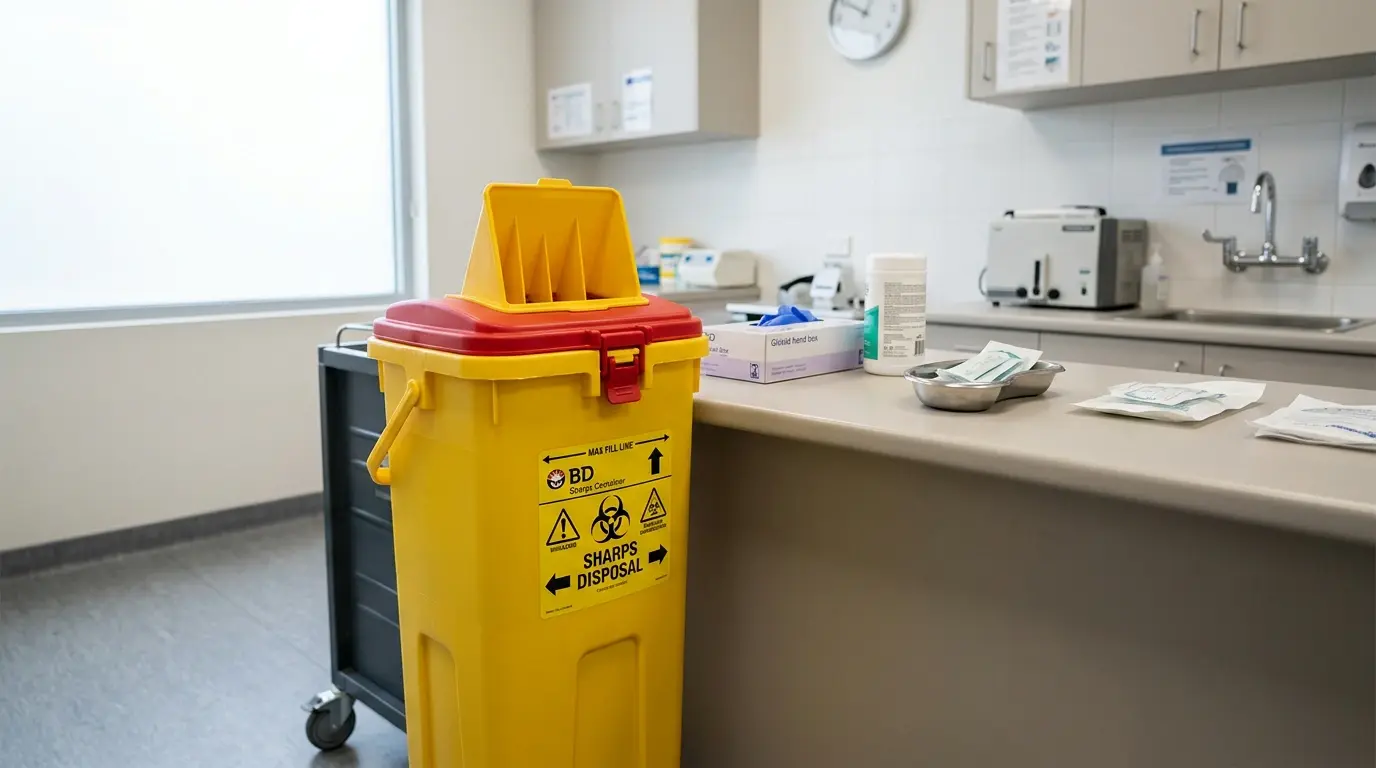
Choosing a standalone sharps disposal unit involves more than finding a container that fits the available space. Buyers should compare the deposit opening, visibility of contents, construction, capacity and configuration to identify an option suited to their workplace.
Cleanpro offers standalone sharps disposal units in various sizes and configurations. Its published product information describes a narrow drop-chute that conceals contents from view, alongside puncture, leak and shatter resistance. Comparing these features alongside the intended application and servicing arrangements can help buyers identify suitable options and determine which specifications need confirmation before purchasing.
1. Drop-chute design: Consider how sharps enter the unit
The opening is an important feature to assess when choosing a sharps container. It influences how users deposit sharps and whether the contents remain visible during ordinary use.
Cleanpro describes its narrow drop-chute as concealing contents from view and helping protect against accidental needle-stick injuries.
When comparing products, consider whether the opening design suits the intended use, whether concealing deposited contents is important for the location, and whether the unit is appropriate for the sharps being disposed of.
Cleanpro also describes its standalone units as being designed to reduce vandalism and access to used needles. This is a separate consideration from the drop-chute itself and may be relevant when assessing where the unit will be installed.
Neither the opening design nor the concealment of contents should be treated as a guarantee against every sharps-related risk. Suitability also depends on the specific unit, its intended application and appropriate handling procedures.
2. Construction: Compare the stated protection features
Construction is another consideration when comparing standalone sharps containers. A general description such as “durable” provides less information than specific product characteristics.
Cleanpro describes its standalone units as puncture-proof, leak-proof and shatter-proof. These are supplier-published claims, so buyers should verify the relevant specifications for the particular unit under consideration.
|
Feature |
What to check |
|
Puncture resistance |
Whether the unit's construction is suitable for its intended sharps. |
|
Leak resistance |
Whether the documented leak-resistance characteristics suit the application. |
|
Shatter resistance |
Whether the stated construction meets the requirements of the intended use. |
These characteristics should be assessed individually rather than treated as a blanket safety guarantee. Buyers should also confirm the relevant product standard and any applicable workplace requirements before making a final selection.
Which Australian standard applies?
Cleanpro's published product page references AS 4031:1992. This standard has been superseded by AS/NZS 23907:2023, which incorporates Amendment 1 issued in 2025.
The newer standard covers sharps-container design and testing requirements. However, the published reference to the older standard does not establish whether a particular unit has been assessed against the newer requirements.
Before purchasing, ask Cleanpro to confirm the applicable standard, the specific unit's documented compliance status and any relevant workplace requirements. Do not assume that compliance with the newer standard has been established without supporting documentation.
3. Capacity: Compare the available sizes
Capacity is an important consideration because the container needs to suit the intended application. Cleanpro's published medical-waste page lists standalone sharps disposal units in the following capacities:
|
Listed capacity |
|
|
|
|
|
|
|
|
|
|
Source: Cleanpro's medical-waste and sharps service page. Confirm current availability and specifications with Cleanpro before ordering.
These options provide a range of capacities to consider, but volume alone does not determine the most suitable unit. Buyers should assess the amount of sharps generated, the available space, the unit's dimensions and how frequently the container can be serviced or replaced.
Collection frequency and replacement arrangements can influence capacity selection. A unit that suits the available space may not be the most practical option if its capacity does not align with the site's expected usage and servicing schedule.
Rather than assuming that a larger container is always preferable, buyers should discuss expected waste volumes and service requirements with Cleanpro to help identify suitable options. The final selection should be based on the specific product specifications and intended application.
4. Configuration and servicing: Match the unit to the workplace
The right configuration depends on where the unit will be positioned and how it will fit into the workplace. Cleanpro states that its standalone units are available in various sizes and configurations and offers assistance in identifying a suitable option.
Before selecting a unit, consider:
- Location and dimensions: Confirm the available space and check the product's physical measurements.
- Intended application: Ensure the proposed unit is appropriate for the sharps generated in that setting.
- Access and positioning: Consider how users will access the deposit opening during normal use.
- Servicing arrangements: Discuss expected waste volumes, collection frequency and replacement requirements when assessing capacity.
- Available configurations: Confirm which sizes and configurations are currently available for the intended application.
Cleanpro's medical-waste service information also describes scheduled and on-call servicing options. Buyers can discuss the arrangements available for their site rather than treating container selection and servicing as entirely separate decisions.
Standalone sharps units should also be distinguished from secure external enclosures designed for public-area sharps disposal. These are different product types and should be assessed according to the requirements of the intended installation.
5. A practical comparison checklist
Before choosing a standalone sharps disposal unit, use the following questions to organise the remaining purchasing decisions.
|
Comparison criterion |
Question to ask |
|
Drop-chute and visibility |
Does the opening design suit the intended use, and are the contents concealed from view as required? |
|
Construction |
Are the stated puncture, leak and shatter resistance characteristics documented for the specific unit? |
|
Capacity |
Does the listed capacity suit the expected volume of sharps and planned servicing arrangements? |
|
Configuration |
Does the unit fit the available space and intended application? |
|
Product compliance |
Has Cleanpro confirmed the applicable standard and documented compliance status? |
|
Servicing |
Are the available collection and replacement arrangements suitable for the site? |
This checklist helps buyers identify which details are already established and which require confirmation. It also provides a practical basis for discussing suitable options with Cleanpro without assuming that every unit has identical specifications.
Find a suitable standalone sharps disposal unit with Cleanpro
Choosing a standalone sharps container involves balancing the opening design, construction, capacity, configuration and servicing arrangements against the needs of the workplace.
Explore Cleanpro's medical-waste and sharps services to review the published options and discuss your requirements with the team. Confirm the selected unit's specifications, current availability, applicable compliance information and servicing arrangements before purchase.