











Infection prevention serves as the foundation of patient safety in every healthcare facility across Perth. While sterilising surgical instruments and sanitising surfaces receives high priority, textile management plays an equally vital role. Bedding, towels, and staff uniforms act as potential reservoirs for harmful pathogens. If not managed correctly, these fabrics become vectors for cross-contamination between patients, staff, and the wider community.
Healthcare administrators must adhere to strict protocols to mitigate these risks. SWS Group supports medical facilities throughout Western Australia with integrated hygiene solutions. Implementing rigorous standards for textile processing ensures that healthcare environments remain safe for everyone.
The Chain Of Infection In Healthcare
Textiles in a clinical setting are frequently exposed to biological fluids and bacteria. Scrubs, gowns, and bed sheets absorb sweat, skin cells, and microscopic contaminants during use. These items become fomites, which are inanimate objects capable of carrying infectious agents.
Pathogens such as Staphylococcus aureus (Golden Staph) and MRSA can survive on fabrics for days. When a nurse or doctor wears a contaminated uniform, they risk transferring these bacteria to vulnerable patients. This transmission route is often overlooked but contributes significantly to healthcare-associated infections (HAIs). Breaking this chain requires professional intervention and industrial-grade cleaning processes.
The Dangers Of Domestic Washing
Many healthcare workers still wash their uniforms at home. This practice introduces significant variability and risk into the infection control strategy. Domestic washing machines are designed for aesthetic cleaning, not clinical disinfection. They typically operate at lower temperatures and use standard detergents that may not kill resilient bacteria.
Furthermore, mixing healthcare uniforms with household laundry creates a cross-contamination risk for the worker's family. There is no way to verify that a home wash has achieved the necessary thermal or chemical parameters. Professional medical uniform laundry eliminates this uncertainty. It provides a validated, documented process that guarantees the removal of pathogens before the garment returns to the ward.
Australian Standards: AS/NZS 4146
In Australia, the processing of healthcare textiles is governed by strict standards. AS/NZS 4146: Laundry Practice sets the benchmark for hygiene in linen and workwear. This standard outlines specific requirements for sorting, washing, drying, and transporting healthcare textiles.
Regulatory Compliance
Facility managers in Perth have a duty of care to ensure their laundry arrangements meet these standards. Accreditation bodies frequently audit hospitals and clinics against these criteria. Failure to comply can result in sanctions and reputational damage.
Partnering with a provider that adheres to AS/NZS 4146 ensures legal and safety obligations are met. It shifts the liability from the healthcare provider to the laundry specialist. This partnership provides peace of mind that infection control laundry services are being delivered according to the highest industry benchmarks.
Thermal And Chemical Disinfection Protocols
Commercial laundry processes rely on a combination of heat and chemistry to achieve disinfection. The standard specifies time and temperature relationships that must be maintained to ensure bacterial kill rates.
Thermal Disinfection
Thermal disinfection involves maintaining a high temperature for a set period. A common standard is a wash temperature of 65°C maintained for not less than 10 minutes, or 71°C for not less than 3 minutes. These temperatures are sufficient to destroy most vegetative bacteria and viruses.
Domestic machines rarely sustain these temperatures accurately. Commercial tunnel washers and barrier machines utilise steam injection to hold these temperatures precisely. Computerised monitoring systems record the data for every load, providing a verifiable audit trail.
Chemical Disinfection
Some textiles cannot withstand high temperatures without degrading. In these cases, chemical disinfection becomes the primary control method. Industrial dosing systems inject precise amounts of alkali, detergent, and sanitiser into the wash cycle.
Peracetic acid or chlorine bleach are often used as oxidising agents. These chemicals break down the cell walls of microorganisms. The pH levels are strictly controlled to maximise antimicrobial action while protecting the fabric integrity. This chemical precision is a hallmark of professional medical uniform laundry operations.
Separation Of Clean And Dirty Workflows
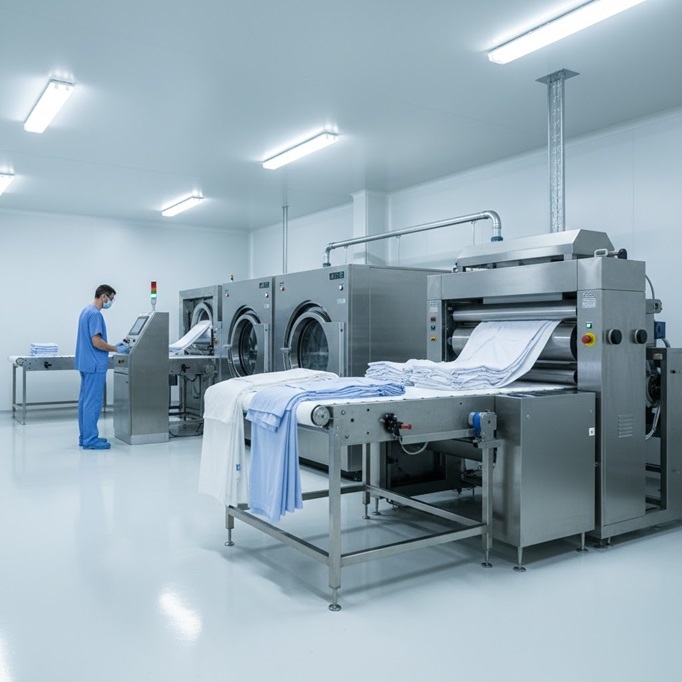
Preventing re-contamination is as important as the washing process itself. In a professional laundry, there is a physical separation between the soiled sorting area and the clean finishing area. This is often achieved through barrier wall technology.
The Barrier Concept
Washer-extractors are built into a wall that divides the facility. Soiled linen is loaded on the "dirty" side. The disinfection cycle takes place within the machine. The clean linen is then unloaded on the "clean" side of the wall.
Airflow is managed to ensure air moves from the clean side to the dirty side, never the reverse. Staff working on the dirty side do not enter the clean side without changing PPE and following strict hand hygiene protocols. This infrastructure prevents airborne bacteria from settling on freshly washed goods.
Managed Workwear Rental For Healthcare
Managing a fleet of uniforms for a hospital or clinic is a logistical challenge. Staff turnover, sizing changes, and wear and tear require constant attention. Implementing a workwear rental program streamlines this process while enhancing infection control.
Scrub Management
Cleantex offers comprehensive rental solutions for medical scrubs and lab coats. Rental programs ensure that garments are maintained to a high standard. Damaged items are repaired or replaced automatically.
Crucially, a rental model supports the "change at work" policy. Staff arrive in street clothes, change into a clean uniform for their shift, and place the soiled uniform in a designated bin before leaving. This prevents contaminated workwear from leaving the facility and entering the community. It creates a closed loop that significantly boosts hygiene security.
RFID Technology
Modern medical uniform laundry utilises RFID tracking. Tiny chips embedded in the garments allow for individual tracking. Managers can see exactly when a uniform was last washed and where it is in the cycle. This technology helps prevent stock loss and ensures that every staff member has adequate uniform allocations.
Linen Management In Clinical Settings
Beyond uniforms, healthcare facilities generate vast quantities of flat linen. Bed sheets, pillowcases, blankets, and patient gowns require the same rigorous processing.
Sterile Supply
Cleantex provides linen rental services that guarantee a steady supply of fresh textiles. In a hospital setting, shortages of clean linen can delay admissions and surgeries. A managed service predicts usage peaks and adjusts delivery schedules accordingly.
Handling Infectious Linen
Linen soiled with blood or bodily fluids requires special handling. It is typically placed in alginate bags that dissolve in the wash. This means laundry staff do not need to handle the soiled items directly. The bag is thrown into the machine unopened, reducing exposure risks. This protocol is a critical component of infection control laundry services.
Transport And Logistics Hygiene
The journey between the healthcare facility and the laundry plant presents risks. Clean linen must be protected from environmental contamination during transit. Conversely, soiled linen must be contained to prevent leakage or aerosolisation of pathogens.
Vehicle Segregation
Transport vehicles are often divided into clean and dirty sections. Alternatively, separate vehicles are used for delivery and collection. If the same vehicle is used, the cargo area is chemically sanitised between the unloading of dirty goods and the loading of clean goods.
Trolley Hygiene
Linen trolleys traverse hospital corridors and laundry floors. They can harbour bacteria on wheels and handles. Professional services employ trolley wash stations. Trolleys are sanitised before being loaded with clean linen. Plastic liners or covers protect the clean linen from dust and moisture during the delivery run.
Floor Hygiene In Medical Facilities
Floors in healthcare settings are high-traffic zones. Patients, staff, and visitors track in contaminants from the street. Wheelchairs and gurneys bring in dirt and bacteria from car parks and ambulance bays.
Entrance Matting Strategies
Preventing dirt ingress is vital for maintaining a sterile environment. Floor mat rental services place high-performance mats at all entry points. These mats scrape debris and absorb moisture before it reaches the clinical areas.
Cleantex offers specialised entrance matting solutions that support hospital hygiene. Clean, dry floors also reduce slip hazards, protecting frail patients and rushing staff. Mats can also be placed in transition zones, such as outside operating theatres, to capture fine dust.
Staff Safety And PPE
The safety of the laundry workforce is paramount. Handling soiled healthcare linen exposes staff to potential sharps (needles left in pockets) and biological hazards.
Protective Protocols
Staff in the sorting area wear heavy-duty gloves, aprons, and face protection. Automated sorting systems reduce the need for manual handling. Staff are vaccinated against Hepatitis B and other relevant diseases.
Strict protocols dictate how to handle "sharps" found amongst the linen. Safe disposal units are available at every workstation. Prioritising staff safety ensures a stable workforce and consistent service delivery. Reliable infection control laundry services depend on the wellbeing of the people operating the machines.
Sustainability In Healthcare Laundry
Healthcare facilities are under increasing pressure to reduce their environmental impact. Laundries consume significant amounts of water and energy. However, large-scale commercial laundries are far more efficient than domestic or on-premise laundries (OPLs).
Efficiency At Scale
Continuous batch washers (tunnel washers) recycle water internally. The rinse water from the end of the process is filtered and used for the pre-wash at the start. Heat exchangers capture energy from wastewater to warm up the incoming fresh water.
By consolidating the washing volume of multiple hospitals, a commercial plant achieves economies of scale. This results in a lower carbon footprint per kilogram of linen processed. Choosing professional medical uniform laundry is often the greener choice for eco-conscious healthcare providers.
The Role Of Independent Audits
Trust is essential, but verification is better. Reputable laundry providers engage independent microbiologists to test their output. Swab tests are taken from finished linen to ensure bacterial counts are below the threshold set by AS/NZS 4146.
These test results are shared with healthcare clients. They provide empirical evidence that the disinfection process is working. This transparency builds a partnership based on safety and compliance. It allows healthcare administrators to prove to accreditation surveyors that their linen supply is safe.
Conclusion
Hygiene in healthcare extends far beyond the operating theatre. It encompasses every fabric that touches a patient or staff member. The risks of domestic washing and poor linen management are too high to ignore. Professional laundry services provide the thermal precision, chemical validation, and logistical security required to break the chain of infection.
SWS Group delivers integrated textile solutions that meet the rigorous demands of the Western Australian healthcare sector. From managed scrubs to sterile linen supply, the focus remains on safety and reliability. Ensuring compliance with AS/NZS 4146 protects vulnerable patients and dedicated staff alike.
For tailored hygiene solutions, call (08) 9336 6944 to discuss specific requirements. Get in touch to arrange a consultation.